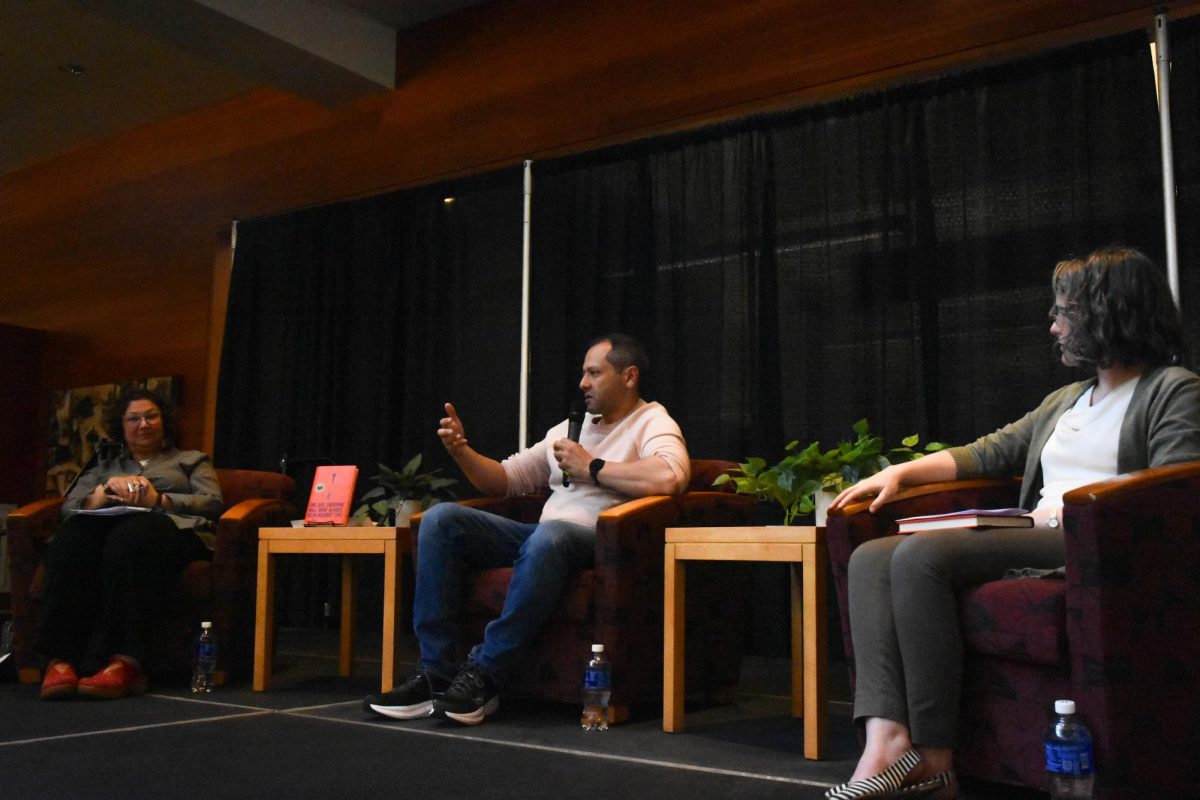
One Day, Everyone Will Have Always Been Against This is an observation about the current conflict between Israel and Palestine and the title of a book by Omar El Akkad, who came to Linfield on Apr. 8 to speak as part of the Learning Across Boundaries program. Akkad is an immigrant, going from Egypt to Qatar to Canada and finally to the US, and a journalist who has covered previous conflicts in the Middle East as well as the politics of America.
The book was originally titled Glass Coffin, but in 2023, he retweeted a video of Gaza after bombings from Israel, writing, “One day, when it is safe, when there is no personal downside to calling a thing what it is, when it’s too late to hold anyone accountable, everyone will have always been against this.”
The current title points to a potential future after the genocide in Palestine where it is safe and uncontroversial enough to be widely condemned.
“I was thinking about how today, you can’t really find a good, well-meaning liberal who will tell you that at one point they were in favor of South African Apartheid,” El Akkad said. “That person doesn’t exist.”
Similarly, the original title of “Glass Coffin” pointed to the common resistance to directly acknowledging tragedies, whether that involves just talking about them or directly showing the death they cause.
“In these moments of very grotesque asymmetry of power, one of the things that the powerless can do that is deemed most offensive by the powerful is simply show the body,” El Akkad said.
A major throughline in both the book and the lecture is the various ways that El Akkad and others grapple with these tragedies, and how this book has created a space for this process.
“I think there’s a lot of people who feel like they’re losing their minds,” El Akkad said. “You wake up every day and you see the worst thing imaginable, and your tax money’s paying for it, and you’re being told that if you stand against this in any way you’re the bad guy.”
According to El Akkad, many immigrants have a unique perspective on the issue. In his own experience, the feeling of being on unsteady ground with regard to culture and regional identity caused him to cling to narratives about America like a lifeline, and the genocide in Gaza revealed a chasm between those narratives and reality. The book centers on this chasm.
“No matter how bad it gets here, there’s this underpinning of law and equal rights and internationalism,” said El Akkad. “The last two years have sort of shattered my ability to just hold onto that at any cost, because every day I’m seeing it debased.”
On top of that, El Akkad spoke about the intertwined nature between different instances of colonialism and hegemony, something that, according to him, many of the college students he talks to have a strong understanding of.
“There’s a connection between this (colonialism) and the fact that because of the way we’ve arranged the society and the intense insatiable greed of very few people, you will probably never own a home,” said El Akkad. “And that’s the least of your worries, because [that] same greed [means], this planet might become uninhabitable for you.”
El Akkad expressed a need for people to avoid willfully turning away from these injustices. However, this is not an easy thing, and it does come with downsides.
“I certainly don’t think that it’s good for a human being to be this engaged with horror on a constant basis that is so immediate and so instant,” said El Akkad. “The only question is whether it’s worse to be disengaged, particularly when this is being done on your behalf.”
After writing One Day, Everyone Will Have Always Been Against This, El Akkad found himself meeting many activists for the cause of Palestinian freedom, and through these people, saw the side effects of this constant engagement. Long periods of not looking away from these injustices and experiencing pushback from people against the movement makes people angry, and it makes politeness and civility challenging.
Once it won the National Book Award, El Akkad found himself in even more new spaces meeting new people who further informed his perspective, specifically on the consequences of not engaging.
“There’s a direct connection between how civil you can be and how much you look away from,” said El Akkad.
Despite the difficulty of being aware of Israel’s wrongdoing and the US’s complicity, El Akkad maintains that being aware of the truth is better in the long run.
In his book, El Akkad spoke about recent elections, particularly the concept of voting for the lesser evil. In 2024, many debates were had on the left about the morality of abstaining from voting for Harris based on her lack of support for Palestinian freedom. Some argued morally against her positions, saying that people shouldn’t vote for morally unacceptable candidates or the ‘lesser evil.’ Others argued pragmatically, saying that Harris was a better option than Trump. El Akkad shared that he would personally rather take the route of moral abstention.
“For a year and a half, I watched children get sniped, and then I had a very polite man in a very well tailored suit come up to the podium and speak on behalf of the president to tell me why this was a good thing,” said El Akkad. “And why trying to do anything about it or stop it in any way is an impediment to peace.”
These recent events have made him personally less likely to take the pragmatist route. He understands that perspective and doesn’t judge pragmatist voters even when he questions the framing that emphasizes a lesser evil here over death and destruction somewhere else.
“I think a lot of times when we have this particular discussion, we’re not talking about pragmatism,” said El Akkad. “We’re talking about whose life actually matters, and whose doesn’t.”
Despite everything, El Akkad has hope for the future. He points out that complicity and inaction often have more immediate reward than fighting for a better future, but he’s seen that so many are willing to fight anyway.
“To watch, particularly young people, turn away from self interest in the way of something that is much more predicated on common good and solidarity and our obligation to take care of one another and to love one another, is, by a wide margin, the thing that gives me the most hope for the kind of world that my children can have,” El Akkad said.