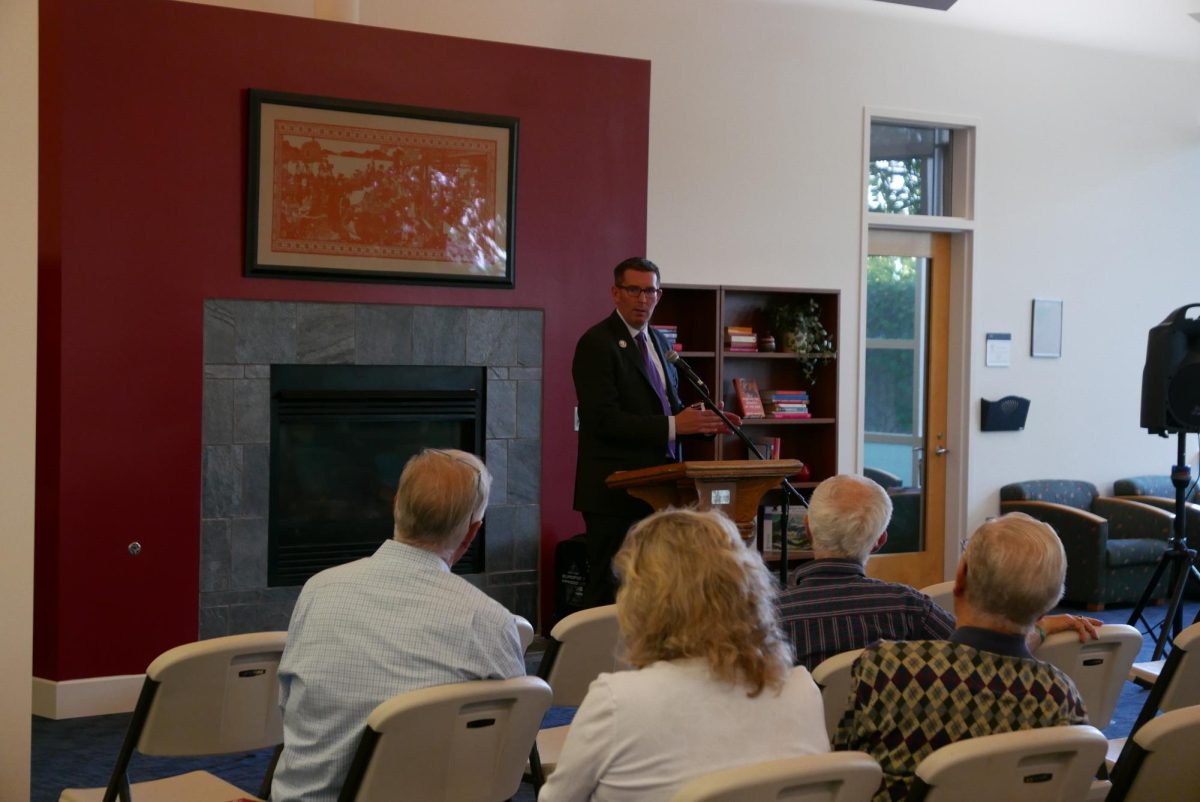
On April 17th, Dr. Lina Kuhn gave a presentation on the concepts she found in Ana Amirpour’s “The Bad Batch,” notably desert aesthetics and biopower. She chose this specific movie because it explored the ideas in a method she had not seen before.
“Film as a medium is uniquely able to shed light on our real-world situations, in new and exciting ways,” said Kuhn.
The film takes place in a dystopian alternate future where the U.S. government sends criminals designated as the “bad batch” to a fenced-off section of desert outside Texas. The government exercises biopower, which is the ability to kill those who do not follow norms in methods ranging from expulsion to execution.
Miami Man is in the “bad batch” because he lacked papers when he immigrated from Cuba to Miami, Florida, while the protagonist, Arlen, never has her crime revealed.
Kuhn argued that bodies are cultural artifacts in that they are marked and engraved by social pressure, bearing understandable signs of their meetings with power. Arlen’s prisoner tattoo marks her criminality, while her backpack decorations suggest deviance from the outside culture.
Kuhn listed multiple factors that make the body appropriate, including habits and environment.
As part of her presentation, she showed a clip that takes place at a cannibal bodybuilders’ camp to show the physical contrast between the tan, muscular and partially clothed cannibals and the two prisoners designated as meat, who are paler, fully clothed and missing limbs.
Kuhn argued that the norm of viewing humans as meat only makes sense away from the influence of the outside world. Therefore, grotesqueness arises whenever another group’s norms contradict our own.
“In general, I use the theory of biopower to think through how dystopian deserts might create groupings of people that are somehow different from those found in our reality,” said Kuhn. “I show how close attention to bodies and the aesthetic grotesque is able to reveal some of those differences.”
The glee of survival at the margins may appear grotesque, but it is no less real. Kuhn played a scene where Arlen experiences a hallucinatory vision and finds herself enjoying blending in with the universe, becoming one with the desert to show this glee.
In the latter half of the presentation, Kuhn introduced a cult from the film called “The Dream” whose leader lives in a grand house with his pregnant wives. He offers Arlen the dream of being his wife, but she rejects his attempt to shape her body.
The cult leader rules the town of Comfort, which imitates the outside world by offering conveniences such as air conditioning and noodles. He uses a hallucinogenic drug called “Dream” to keep the cult under his sway, though he also calls it life, like the life inside his wives.
The film ends with Arlen wandering with what Kuhn called a nuclear family, Miami Man and Honey, rejecting the desert norms. For Kuhn, this presentation was an opportunity to workshop her theories.
“One great thing about working as an academic is that you are always able to continue learning, doing research, and sharing that research with others,” said Kuhn. “Giving lectures such as this allows me to test out new ideas and get feedback from audiences, as well as think through the research I am conducting.”
The lecture was the final one she will give; she is now expanding it into a full peer-reviewed research article, with hopes of getting it published.