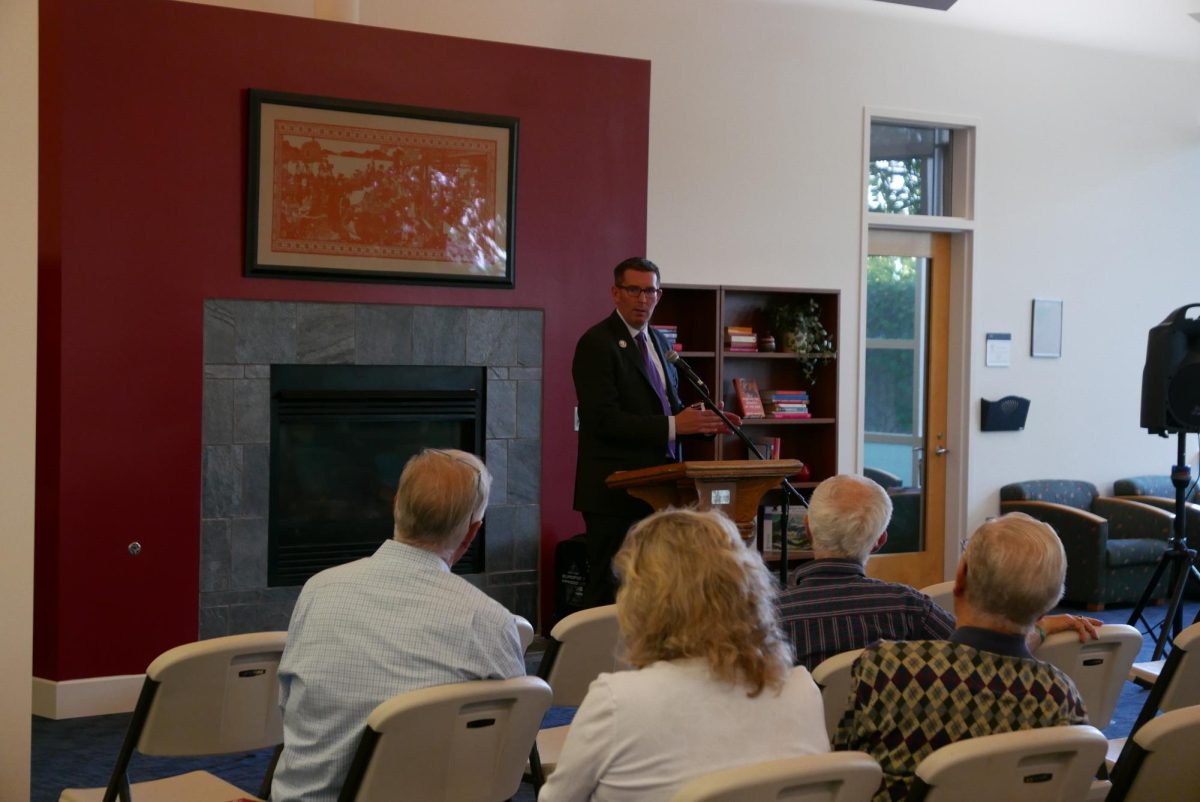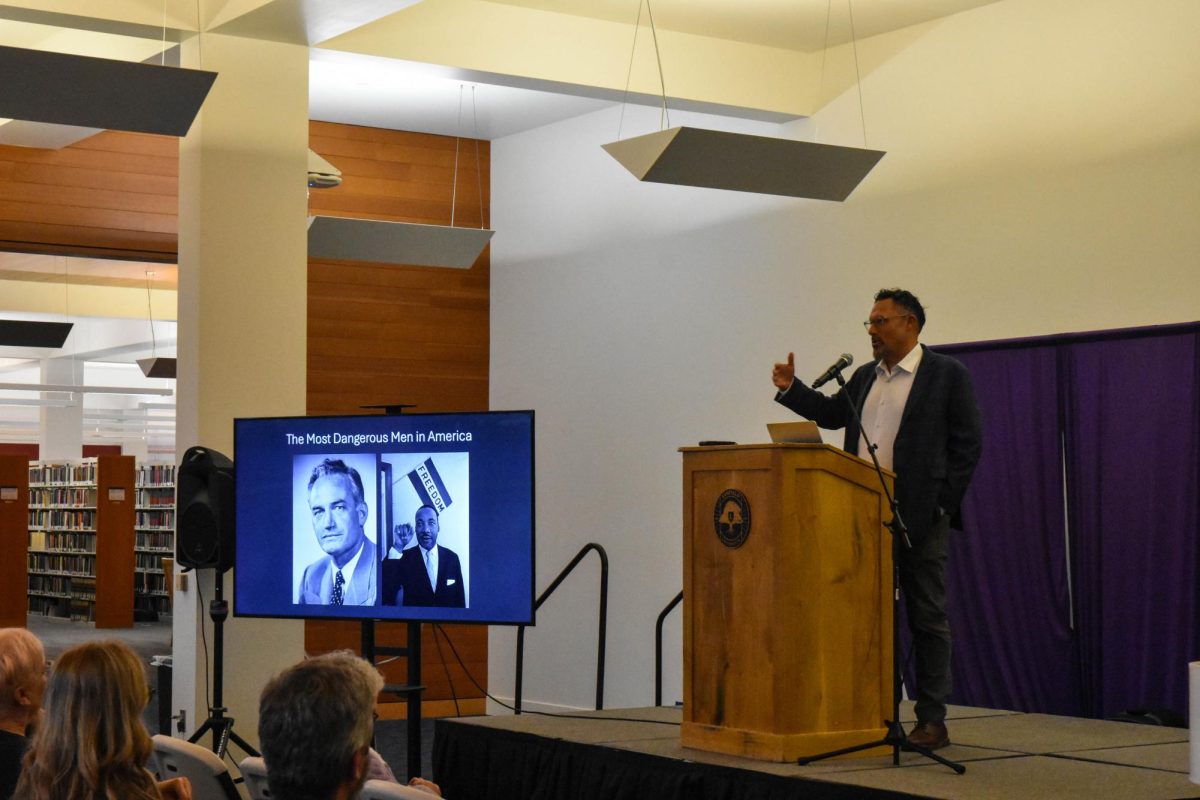
Even in incredibly polarized times, both sides of the aisle often land on the same beats, such as affordability or freedom, while at the same time, having fundamental disagreements. This juxtaposition is the subject of Nicholas Buccola’s book, One Man’s Freedom: Goldwater, King, and the struggle over an American Ideal. He came to Linfield to give a lecture on this book on Mar. 10, as part of the Frank Larsell lectureship, a tradition of speakers sharing their insights on history.
The book is centered around two historical figures: Republican senator and presidential nominee Barry Goldwater and civil rights activist Martin Luther King. These two men rose to political prominence concurrently, and nominally, they had the same goal and core value: freedom. However, they operated in entirely different political spheres. King was an advocate for integration, the end of Jim Crow, and racial justice, while Goldwater was a proponent of states’ rights and remained hands off with regards to racial equality. This simultaneous conflict and nominal agreement is what Buccola seeks to investigate.
“So you have two movements that are operating under the banner of freedom,” Buccola said. “And they’re viewing each other with a great deal of suspicion, even hostility.”
Both of these figures were incredibly polarizing in their time, adding to this hostility that Buccola describes. One particular thing he highlights is the phrase “most dangerous man in America,” which was widely used to describe King. Goldwater gained widespread publicity during his presidential run, and Buccola shares a quote from King following his defeat at the primary to show what this hostility looked like.
“Until that defeat, Goldwater was the most dangerous man in America,” said King. “He talked soft and nice, but he gave aid and comfort to the most vicious racists and the most extreme rightists in America.”
Goldwater’s background is primarily in business. He inherits his father’s department store, where he then works, and when he gets to the senate, he realizes he’s out of his depth. But, while he might not have strong political skills, he does have his sales experience.
“Goldwater is kind of a major contribution to American commerce. But he goes to Washington, he has a new product to sell, and that is conservatism,” said Buccola.
So, Goldwater begins selling conservatism to the American people. He goes about this, primarily, by asserting that our freedom is in peril, and that the two main threats are “big government and big labor.” Interestingly, Buccola points out a gendered element to Goldwater’s rhetoric.
“The left wing pack has given out, quote, a dole of inflated greenbacks as a pacifier for your lost manhood,” said Buccola, quoting Goldwater.
Martin Luther King did not always have aspirations toward politics. He was a preacher with hopes of being a professor, but the Montgomery bus boycott pulled him into the fold. These bus systems were segregated, but there was also active mistreatment of black riders by bus drivers. In a sense, the boycott and its demands were put together by King and the Montgomery Improvement Association, but in another sense, they were put together by thousands of Montgomery residents who were tired of being harassed and discriminated against.
“Rather than seeing freedom as rugged individualism, King begins to see freedom as conscientious collaboration,” said Buccola.
As a political figure, Goldwater was by no means pro-civil rights, but parts of his personal life make his opinions on issues of racial equality difficult to pin down. When he was the head of the Air National Guard, he desegregated his unit, and as a Senator, he hired a black woman to be a legislative aide. However, there were many times where he was noticeably silent on the issue of civil rights. As a senator, he is asked to give a speech in South Carolina, and he criticizes the left for “magnifying the differences among them in order to promote a politics that is fundamentally negative and divisive.”
The way Buccola explains it, Goldwater exists in almost a liminal state, between the avid segregationists and civil rights activists.
“My previous book was about working behind the scenes with these segregationists and supporting them in all sorts of ways,” said Buccola. “Goldwater is kind of doing that, but in a way that it doesn’t seem fully cognizant of what he’s doing.”
Finally, Buccola brings the audience back to the fundamental juxtaposition at hand. He tells a story of a civil rights protest at Monson Motor Lodge, a segregated, white hotel, where white activists get rooms and then open a gate, allowing black activists to run in and enter the pool. In response, the hotel owner, Brock, poured muriatic acid into the pool to try to injure them.
“…whose claim to freedom do we find to be more compelling?” he said.
When Goldwater stands behind the idea of freedom, it’s the freedom of Brock and other business owners to decide who to allow into their business, even if it’s discriminatory. When King invokes freedom, he’s invoking the freedom for everyone to move through society with dignity.
Despite the historical setting, Buccola’s work is highly relevant to the current political landscape. The themes of this particular book are pulled from the ‘60s, which is in living memory for many. Much of what he described is still happening today, whether it’s discrimination or disagreement on what freedom truly means. Buccola urges students to learn from these historical figures, and apply that knowledge to their own lives.