Last February it was announced Linfield University was facing a $4.9 million deficit. Throughout last spring, the school went through a variety of changes that has trimmed it to $1.7 million for the current fiscal year. The deficit needs to be at zero by the next fiscal year in accordance with a Board of Trustees resolution. Many of these changes materialized in program and faculty cuts in a process known as Reorganization, Organization and Merger (REM).
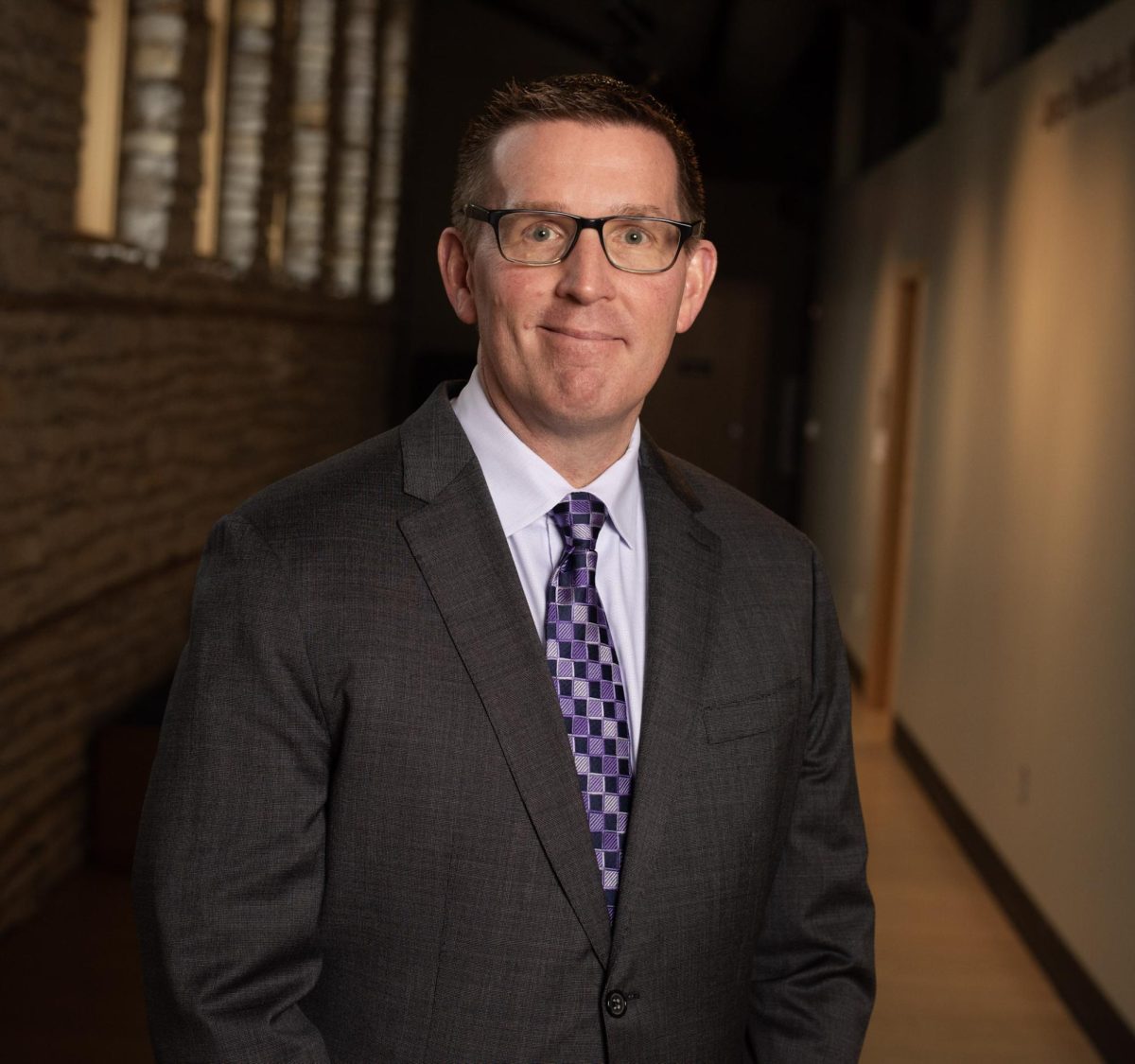
As Linfield enters the second iteration of the REM process, the person guiding the ship has changed. Mark Blegen took over as university president and was charged with seeing through the conclusion of the Balanced Budget Initiative and ensuring sustainability for the school in the future.
On March 5, the first draft of the REM proposal was posted on Linfield Central. The proposal detailed 14 programs that are proposed to undergo changes. Digital art, computer science, international relations, public health – health promotion and the masters program in sports science and analytics would be cut . Most of these programs are aspects of larger departments, meaning full departments aren’t being eliminated entirely.
Chemistry, music, philosophy, theatre and potentially history and sports economics would only be offered as a minor. Creative writing and literature would be folded into English. The humanities track in environmental studies would be eliminated along with the public relations and content creation tracks in journalism and media studies. jour
Blegen is trying to ensure these changes in the REM proposal are reversible if Linfield’s situation allows for it later down the line.
“Rather than cutting it, can we make it a minor,” Blegen asked. “Because if we make it a minor, then drive enrollment, we can reverse it and make it a major again. It’s almost trimming back to grow for the future.”
Feedback from College of Arts and Sciences (CAS) faculty is due March 23. A second proposal will be released March 30. Blegen also is looking for feedback from students.
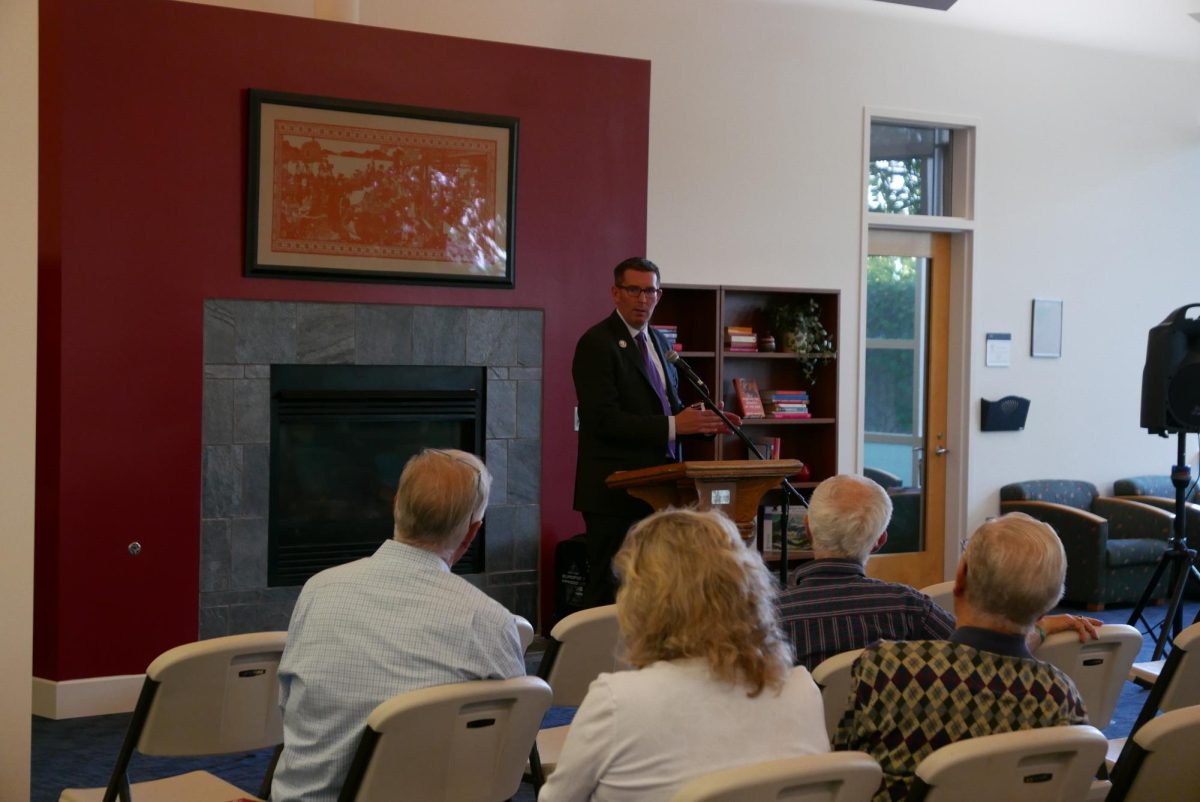
“We’re creating something called Pizza with the Presidents,” Blegen said. “Where students can come, have some pizza, talk to me, ask questions, be mad at me if they’re mad about something, but hopefully develop relationships with the students.”
Pizza with the Presidents events would be meetings with Blegen and the current ASLU president.. These events would be communicated to students through email, Linfield Central and Linfield Ahead.
The first Pizza with the Presidents will be on March 17 at noon in Riley 201. Students are encouraged to RSVP to ensure enough pizza is provided. An email from the president’s office also announced that events will be held in April specifically for CAS students. Dates, times and locations will be announced in the coming weeks.
The current timeline for the proposal, according to a Central post from provost and vice president of academic affairs Beth Concepción, puts the first round of faculty feedback being due on March 23. A revised proposal would be sent to CAS faculty on March 30, with a second round of feedback due on April 13. A second revised proposal would be sent to CAS faculty on April 20, with the end of CAS deliberation being on May 4. A final plan to balance the budget will be presented on May 7 at the Board of Trustees meeting.
Blegen did make clear that those whose programs are cut during the process will still get the opportunity to finish their program. This is identical to the Teachout program that was announced last year. Blegen also committed to ensuring program quality.
“If we’re closing a program, those faculty will still be around to teach that program,” Blegen said. “In the event that those faculty would decide to leave on their own because the program was closing, we would have to ensure that we’ve got wonderful adjuncts [to teach].”
Blegen also said he would work to take steps to ensure that additional opportunities like research or independent studies aren’t lost for affected students; they have often been cited as major reasons people went to Linfield.
It will also be communicated to incoming students over the summer how program changes will affect those students. Last year a handful of students interested in studying Japanese at Linfield were told a month before the fall semester started that they would be unable to enroll in the program. Some students have said they are wary in recommending friends enroll at Linfield out of fear that may happen to them. Blegen said Linfield will be proactive in communicating with these students.
“We have to have a conversation with [an affected] student and their family to say, here’s what’s going on,” Blegen said. “Would you like to come to Linfield and think about a different major? Or can we help you land a spot in another institution? That’s kind. And above everything, we need to be kind.”
At a staff town hall on Feb. 24, Blegen announced that $950 thousand in faculty pay would need to be cut as part of the quest to eliminate the current $1.7 million deficit. There is no set amount of faculty that will be let go, it is solely a mission to reach that number. When asked, Blegen said reducing pay of faculty who remain is currently not being discussed.
Superdepartments are also on the table as it comes to the REM process.
“At my former institution, all of the departments there were what we would call [at Linfield] superdepartments,” Blegen said. “We just called them departments. At Linfield, programs have defined the department. I can’t tell you right now exactly where that conversation is at because that’s more of [Concepción], but it’s something we need to look at.”
If superdepartments are implemented, it would not affect degree offerings. For example, last year a proposed superdepartment would be a merger of the department of political science and the department of journalism and media studies. Under a combined department, a student could still get a degree in solely political science with no change in curriculum compared to what it would be currently. That student would not be forced to take any JAMS related classes to fulfil political science requirements.
Superdepartments would just be an ordering group, like the School of Business houses finance, marketing and other programs.
Blegen is hoping that once the budget is balanced, the university can look at the future. He says that right now, Linfield is in a good place. He referenced budget crises at other universities, saying that comparatively $1.7 million is small. For example, Southern Oregon University recently made faculty cuts to prevent a $14.6 million shortfall, according to Oregon Public Broadcasting. Also according to OPB, Portland State University has an over $40 million deficit. Even the University of Oregon announced they were facing budget issues and cited budgetary crises at colleges across the country. Linfield’s deficit is much smaller.
Blegen said he is open to any and all feedback by any member of the Linfield community. He said he lives by the mantra of Q-tip, quit taking it personally.
“I hope students understand, whether it’s a pizza with the president, whether it’s email, whether it’s a random conversation on the street, that I’m approachable and I will absolutely hear you and listen to you,” Blegen said.
Blegen welcomes emails with input and feedback from students. You can email him either at [email protected] or [email protected], although the latter gets to him quicker. He hopes that the discussion for the future of Linfield can be one that is open and includes everyone.