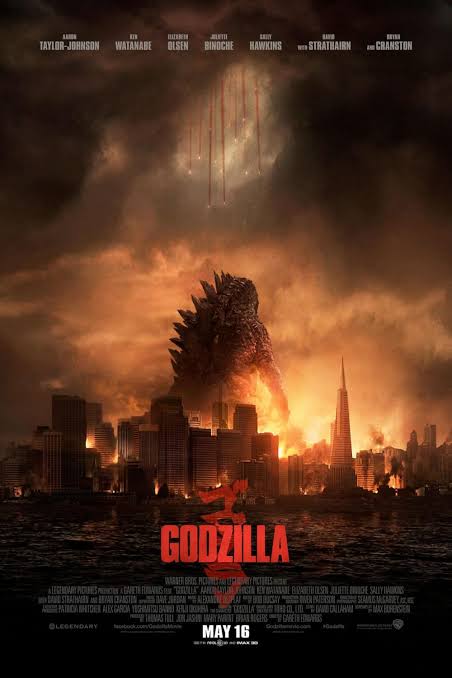
In celebration of “Monarch: Legacy of Monsters” season two releasing this past February, “Godzilla Minus Zero” coming this fall and “Godzilla x Kong: Supernova” coming next year, let’s take a look at the film entries in Legendary’s “Monsterverse.” First on the list: 2014’s “Godzilla” directed by Gareth Edwards and Max Borenstein.
I have an extreme amount of nostalgia for this. Back in 2010 when the project was first announced, I closely followed the preproduction and counted down the days until its May 16, 2014 release date. “Godzilla” (2014) was the first film in the franchise I ever watched in a theater; every other entry I’d seen was viewed from the comfort of my couch.
At the time I first watched it, I thought it was the single greatest piece of film I had ever seen. Of course I thought that, I was 13. The years, however, have been unkind to this film. Nearly a dozen years removed from that initial viewing and countless more watches since then, I have kind of soured on this entry. Prewarning, some light spoilers will be in the review.
For those who may not have seen the film, here’s a brief recap:
In 1999 a Japanese Nuclear reactor is attacked by a MUTO, one of the antagonists monsters of the film, but the event is covered up as a meltdown. Joe Brody (Byran Cranston), a lead nuclear engineer at the plant loses his wife in the incident. Driven by grief and a belief that something deeper is at work, he dedicates his life to uncovering the truth, though it comes at the cost of alienating his son Ford Brody (Aaron Taylor-Johnson).
15 years later, Joe is arrested for trespassing in the same area previously thought to be completely irritated, and is desperate to prove to his son he’s not crazy. At the site, the MUTO awakens, and as a result awakens Godzilla, an ancient alpha predator, and another MUTO. It becomes a race against the clock preventing the two MUTOs from procreating and discerning whether or not Godzilla is friend or foe.
Like I said at the top, I like this film a lot less since the first time I saw it, but there’s still a lot to enjoy, which is why I’ve returned for repeat viewings. First and foremost, Godzilla himself is well characterized and has a fantastic new design. To me, it balances being identifiable as the character while still remaining unique to this new iteration. On top of a new design, Godzilla’s new origins as the last of his species, and being a predator who is millions of years old are an interesting departure from what he usually is. Alongside his origin, this film introduces its cast of giant monsters as “Titans,” a kind of species beyond human comprehension. Future entries in the franchise will expand on this lore in new and increasingly crazy ways.
Another well done element is the sheer scale of these monsters. The monsters feel massive and imposing. Their existence alone causes damage to the environment without ever deliberately attacking. Edward accomplished absolute verisimilitude when it came to these beasts. Something future entries will largely fail to replicate. As a result, the monster fights feel appropriately cataclysmic and chalk filled with excellent moments that remain iconic within the entire franchise. One last element I really loved is Bryan Cranston’s performance. Over a decade into the “Monstervese” and Cryanston still touts the single best performance, with being maybe the most memorable character in the entire film.
It’s a real detriment to the film that at act one turn, he dies. The character we’d built most of our investment and time into is taken and replaced with what is essentially a cardboard box of a character in his son Ford. Ford is an unremarkable and flat character whose purpose is to be our eyes at the feet of these Titans, but as a result, lacks any motivation or anything to do in the story. We have no investment in him and the film doesn’t try to build it either. His main motivation is to make it back home, but he makes decisions which constantly prevent him from doing so.
The rest of the cast isn’t much better off. They’re all charmless exposition machines instead of characters who are interacting with the world and the insane predicament. The tone is quite serious so I see why the characters are following in line, yet that’s no excuse to have static, uninteresting characters. It’s feasible to have great spectacle and quality characters; unfortunately, “Godzilla” (2014) misses the mark.
While Godzilla sports a great new design, his foes, the MUTOs didn’t receive such attention. They’re big grey angular monsters. They’re just there to get slaughtered and look uninspired while they do it. Thankfully, after this film the original monster designs get better and better, but it’s a rough start. I mentioned earlier the fights were great, however, there is a small caveat to that. There are three separate times where it appears the monsters are about to fight only for a dramatic cutaway. The first two times were tension building, interesting. The third was frustrating. I would’ve liked a smidge more monster brawls, especially because once Cryanston’s character died, there was nothing left for me to engage with on screen beside Godzilla.
With my most recent viewing, it certainly has fallen in my estimation, however, the parts of it that work, work so well I really can’t help but keep returning to it year after year. In future “Monsterverse” films a lot of what I praised gets expanded and improved on, with the exception of scale. “Godzilla” (2014) is a solid entry into the franchise flaws and all.